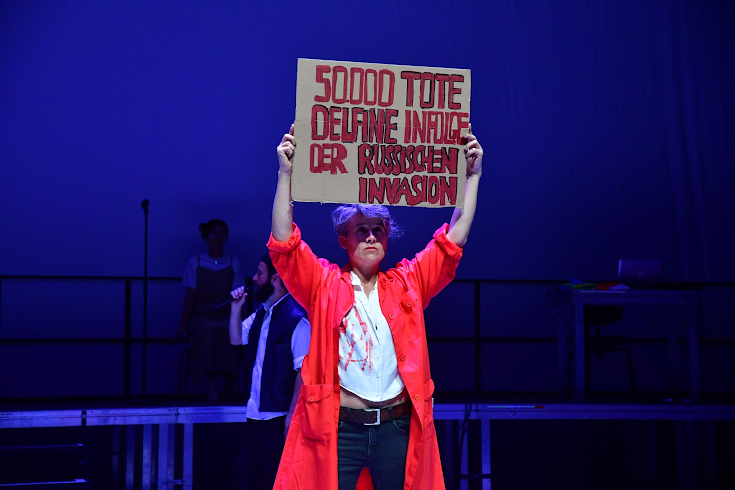
KARABAKH MEMORY (2025)
*українська версія нижче
2025
Maxim Gorki Theater, Studio R
Upcoming performances:
January 17, 2017 (tickets)
September 6–7, 2025 (tickets)
October 18, 2025 (tickets)
"During the war of 2020, when people left their homes, for me the strongest images were those of people who had dug up the bones of their relatives from their graves and burned their own homes. Both actions had the same goal: to prevent these memories from falling into the hands of the enemy.
I remember a YouTube video which showed a man burning his house, and when he was asked why, he said, "This is the end! It’s all over!" I am interested in both of these actions – the exhumation of bones as an attempt to preserve memories and turn them into a kind of souvenir, which symbolically, but also romantically and artificially, represents the past. And the burning of houses as a radical act of forgetting, which gives the person performing the ritual the feeling that they have the ability to act.
History keeps moving on. At the end of September 2023, up to 120,000 Armenians fled from the Azerbaijani troops coming into Nagorno-Karabakh (Artsakh) and went to Armenia, including Roza Sarkisian’s father. He packed his belongings, took a few last photos of the family home, packed some earth in a small mason jar and set off on the arduous journey. Director Roza Sarkisian developed Karabakh Memory around her family history, and around individual mementos – the curse and blessing of remembering.
reviews
Maxim Gorki Theater, Studio R
Upcoming performances:
January 17, 2017 (tickets)
September 6–7, 2025 (tickets)
October 18, 2025 (tickets)
"During the war of 2020, when people left their homes, for me the strongest images were those of people who had dug up the bones of their relatives from their graves and burned their own homes. Both actions had the same goal: to prevent these memories from falling into the hands of the enemy.
I remember a YouTube video which showed a man burning his house, and when he was asked why, he said, "This is the end! It’s all over!" I am interested in both of these actions – the exhumation of bones as an attempt to preserve memories and turn them into a kind of souvenir, which symbolically, but also romantically and artificially, represents the past. And the burning of houses as a radical act of forgetting, which gives the person performing the ritual the feeling that they have the ability to act.
History keeps moving on. At the end of September 2023, up to 120,000 Armenians fled from the Azerbaijani troops coming into Nagorno-Karabakh (Artsakh) and went to Armenia, including Roza Sarkisian’s father. He packed his belongings, took a few last photos of the family home, packed some earth in a small mason jar and set off on the arduous journey. Director Roza Sarkisian developed Karabakh Memory around her family history, and around individual mementos – the curse and blessing of remembering.
reviews
Wut und Selbstzerfleischung | taz, Tom Mustroph
“The play is pure rage. Roza, embodied by Flavia Lefèvre, does not simply recount the flight and expulsion of the Armenian population from Artsakh between 2020 and 2023. She tears the story straight from her own entrails.”
“Through numerous slapstick interludes – such as selling soil from Artsakh – Lefèvre and her fellow performers, Alexandra Malatskovska and Tim Freudensprung, repeatedly break the fury. Yet grotesque and rage also fuel one another.”

Komedia o ludobójstwie | Didaskalia 187/188, Ewa Bal
“Sarkisian is not a director who uses theatre to demand redress… she has always looked with distrust and from an angle at any manifestations of homogeneous collective identity.”…In her performance the subject of analysis becomes two seemingly contradictory functions of memory: deliberate forgetting and the involuntary urge to commemorate…Roza Sarkisian does everything to avoid slipping into the tone of a martyr-like vivisection of her own life. She transforms stage reality into a theatrical laboratory of trial and error…
…Memory and nostalgic longing for home are presented here as vomiting and defecation… memory and nostalgia, like diarrhea and vomiting, appear as an indecent, uncontrollable, sudden and embarrassing bodily function…Instead of reinforcing structures of memory, Sarkisian piles up diverse mediations on stage in order to examine their external forms – at times comic, at times terrifying…The performance becomes a necessary laboratory of representation, commemoration and working-through of trauma, where liberating bursts of laughter coexist with horror and dread.”
team
Director: Roza Sarkisian
Stage design: Dana Kavelina
Costume: Dana Kavelina, Julia Radewald
Music: Alexandra Malatskovska
Video: Magda Mosiewicz
Lighting design: Daniel Krawietz
Dramaturgy: Johannes Kirsten
cast
Tim Freudensprung
Flavia Lefèvre
Alexandra Malatskovska
“The play is pure rage. Roza, embodied by Flavia Lefèvre, does not simply recount the flight and expulsion of the Armenian population from Artsakh between 2020 and 2023. She tears the story straight from her own entrails.”
“Through numerous slapstick interludes – such as selling soil from Artsakh – Lefèvre and her fellow performers, Alexandra Malatskovska and Tim Freudensprung, repeatedly break the fury. Yet grotesque and rage also fuel one another.”
Komedia o ludobójstwie | Didaskalia 187/188, Ewa Bal
“Sarkisian is not a director who uses theatre to demand redress… she has always looked with distrust and from an angle at any manifestations of homogeneous collective identity.”…In her performance the subject of analysis becomes two seemingly contradictory functions of memory: deliberate forgetting and the involuntary urge to commemorate…Roza Sarkisian does everything to avoid slipping into the tone of a martyr-like vivisection of her own life. She transforms stage reality into a theatrical laboratory of trial and error…
…Memory and nostalgic longing for home are presented here as vomiting and defecation… memory and nostalgia, like diarrhea and vomiting, appear as an indecent, uncontrollable, sudden and embarrassing bodily function…Instead of reinforcing structures of memory, Sarkisian piles up diverse mediations on stage in order to examine their external forms – at times comic, at times terrifying…The performance becomes a necessary laboratory of representation, commemoration and working-through of trauma, where liberating bursts of laughter coexist with horror and dread.”
team
Director: Roza Sarkisian
Stage design: Dana Kavelina
Costume: Dana Kavelina, Julia Radewald
Music: Alexandra Malatskovska
Video: Magda Mosiewicz
Lighting design: Daniel Krawietz
Dramaturgy: Johannes Kirsten
cast
Tim Freudensprung
Flavia Lefèvre
Alexandra Malatskovska
festivals
Im Rahmen von 100 + 10 – Armenian Allegories
KARABAKH MEMORY
Maxim Gorki Theater, Studio R
Найближчі покази:
17 січня 2017 (квитки)
6–7 вересня 2025 (квитки)
18 жовтня 2025 (квитки)
«Під час війни 2020 року, коли люди залишали свої домівки, для мене найсильнішими образами стали ті, де люди викопували з могил кістки своїх родичів і спалювали власні будинки. Обидві дії мали одну й ту саму мету — не допустити, щоб ці спогади потрапили до рук ворога.
Я пам’ятаю відео на YouTube, де чоловік підпалює свій дім. Коли його запитали — навіщо, він відповів: “Це кінець! Усе скінчено!”
Мене цікавлять обидві ці дії: ексгумація кісток як спроба зберегти пам’ять і перетворити її на своєрідний сувенір, який символічно, але водночас романтизовано й штучно репрезентує минуле. І спалення будинків — як радикальний акт забування, що дає людині, яка здійснює цей ритуал, відчуття здатності діяти».
Історія продовжує рухатися. Наприкінці вересня 2023 року до 120 000 вірмен втекли від азербайджанських військ, що увійшли до Нагірного Карабаху (Арцаху), та вирушили до Вірменії. Серед них був і батько Рози Саркісян. Він зібрав речі, зробив кілька останніх фотографій родинного дому, насипав землі в маленьку скляну банку й вирушив у виснажливу дорогу.
Режисерка Роза Саркісян розробила Karabakh Memory на основі історії власної родини та окремих пам’ятних речей — прокляття й благословення пам’яті.
Рецензії
Wut und Selbstzerfleischung | taz, Tom Mustroph
«Ця вистава — чиста лють. Роза, втілена Флавією Лефевр, не просто розповідає про втечу й вигнання вірменського населення з Арцаху між 2020 і 2023 роками. Вона вириває цю історію просто зі своїх нутрощів».
«Через численні слепстик-інтермедії — наприклад, продаж землі з Арцаху — Лефевр та її партнери по сцені, Александра Малацковська й Тім Фройденшпрунг, знову й знову розряджають лють. Водночас гротеск і лють взаємно підживлюють одне одного».
Komedia o ludobójstwie | Didaskalia 187/188, Ewa Bal
«Саркісян — не та режисерка, яка використовує театр, щоб вимагати відшкодування… вона завжди з недовірою й під кутом дивилася на будь-які прояви гомогенної колективної ідентичності».
«У її перформансі об’єктом аналізу стають дві, здавалося б, суперечливі функції пам’яті: свідоме забування та мимовільний імпульс до вшанування».
«Роза Саркісян робить усе, аби не зісковзнути в тон мученицького саморозтину власного життя. Вона перетворює сценічну реальність на театральну лабораторію проб і помилок…»
«Пам’ять і ностальгія за домом постають тут як блювання та дефекація… пам’ять і ностальгія, подібно до діареї й блювання, виявляються непристойною, неконтрольованою, раптовою та сороміцькою тілесною функцією…
Замість того щоб зміцнювати структури пам’яті, Саркісян нашаровує на сцені різноманітні медіації, аби дослідити їхні зовнішні форми — часом комічні, часом жахливі…
Вистава стає необхідною лабораторією репрезентації, вшанування та пропрацювання травми, де визвольні вибухи сміху співіснують із жахом і страхом».
«Саркісян — не та режисерка, яка використовує театр, щоб вимагати відшкодування… вона завжди з недовірою й під кутом дивилася на будь-які прояви гомогенної колективної ідентичності».
«У її перформансі об’єктом аналізу стають дві, здавалося б, суперечливі функції пам’яті: свідоме забування та мимовільний імпульс до вшанування».
«Роза Саркісян робить усе, аби не зісковзнути в тон мученицького саморозтину власного життя. Вона перетворює сценічну реальність на театральну лабораторію проб і помилок…»
«Пам’ять і ностальгія за домом постають тут як блювання та дефекація… пам’ять і ностальгія, подібно до діареї й блювання, виявляються непристойною, неконтрольованою, раптовою та сороміцькою тілесною функцією…
Замість того щоб зміцнювати структури пам’яті, Саркісян нашаровує на сцені різноманітні медіації, аби дослідити їхні зовнішні форми — часом комічні, часом жахливі…
Вистава стає необхідною лабораторією репрезентації, вшанування та пропрацювання травми, де визвольні вибухи сміху співіснують із жахом і страхом».
Команда
Режисерка: Роза Саркісян
Сценографія: Дана Кавеліна
Костюми: Dana Kavelina, Julia Radewald
Музика: Alexandra Malatskovska
Відео: Magda Mosiewicz
Світловий дизайн: Daniel Krawietz
Драматургія: Johannes Kirsten
Акторський склад
Tim Freudensprung
Flavia Lefèvre
Alexandra Malatskovska