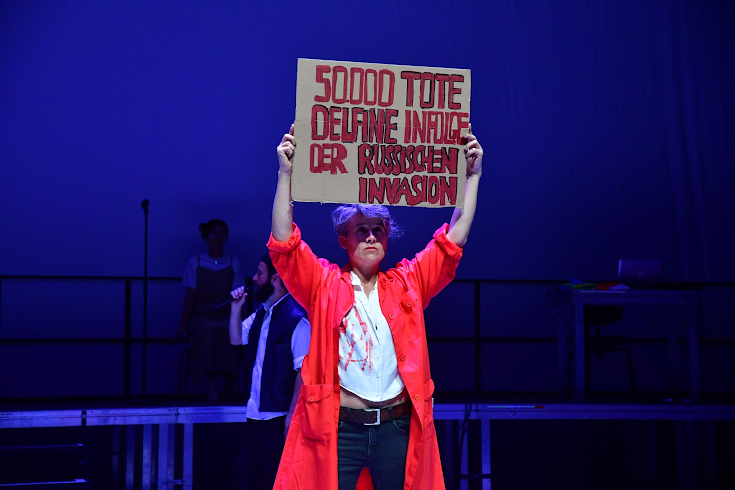
H-EFFECT (2020)
H-EFFECT
EN
post-documentary performance based on the experiences of actors and actresses and inspired by motifs from Shakespeare's Hamlet and Heiner Müller's Hamlet Machine
This is special online version of the show, which will hopefully have its live premiere in 2021. The film media turned out to be an ally in the search for ways to represent the traumatic experience. Trauma is not easy to talk about. Despite the efforts and expectations of the "listeners", it cannot be squeezed into a ready-made narrative form. It breaks through into consciousness in the form of shattered fragments. It does not give in to logic and chronology, escapes from linearity. The construction of the performance is therefore a mosaic: a mosaic of stories, events, quotations from reality, memories and images.

The background of this whole story is the war. You cannot run away from it, you cannot talk about it, but you cannot remain silent about it either. There is no proper language for it, as for trauma. And the one that does exist is full of stereotypes, lies and understatements. Can you break through this wall with your individual experience? Who has the right to do so? What and how can it be said? What will be heard? Who censors our voice and why? Talking about war in a different way than they expect us to, is like moving through a mine field, as it is said in the show: "You can' t go there - a trap. You can't go here - death.” Talking about war is like war itself. And yet each of the characters of the show makes this effort. Each of these fragmentary narratives is different and all are equally precious. Instead of false consolidation, the performance proposes a polyphony of voices, with all the contradictions, conflicts and paradoxes inscribed in it.
Hamlet in "H-Effect" is a compilation of characters from the cult texts of Shakespeare and Heiner Müller and the personal experiences of performers - people who over the past few years have made difficult choices closely related to the history of their country.
This new, hybrid Hamlet migrates between the characters of the show, each of them trying on his skin as well as that of (Müller's) Ophelia.
Among the five protagonists of the performance, coming from Kharkiv, Kyiv, Lviv, Ternopil, Donetsk, two are professional actors: Oksana Cherkashyna - one of the most famous Ukrainian actors of theater and cinema, realizing projects also in Poland and Germany, and Roman Kryvdyk - actor of the Lesia Ukrainka Academic Theatre in Lviv, as well as participant of АТО. The show is also performed by: Oleh Rodion Shuryhin-Gerkalov - a costume designer and stylist, theatre director by education, LGBT activist, Kateryna Kotlyarova - currently documents war crimes and human rights violations, during the Dignity Revolution she was in the units of the Self-Defense of Maidan, then fought in the volunteer battalion "Aydar", Yaroslav Havianets - a lawyer by education, as a soldier of the ATO he participated in the defense of the Donetsk airport in its last phase, before the war he studied acting at the Kotlarewski University in Kharkiv.
The artists not only perform in the play, but are also co-authors of the script largely based on their own texts and acting improvisations.
"H-Effect" is the newest premiere of Rosa Sarkisian - one of the most recognized and distinctive Ukrainian directors, known for such productions as "Psychosis" inspired by Sarah Kane's play and Anne Sexton and Sylvia Plath poems, or Lviv's "Beautiful, beautiful, beautiful times" based on the Elfriede Jelinek's novel. For the third time, the director was collaborated with a well-known Polish dramaturg Joanna Wichowska, who had earlier worked with Oliver Frljic, among others and who is known in Ukraine as the curator of the large-scale performative projects Theater Laboratory "Desant" and "Maps of Fear / Maps of Identity".
The performance "H-Effect" is an international project created by artists from Ukraine, Poland and Germany. It will become a basis for the film "Hamlet Syndrome", which is currently being developed by the award-winning Polish directors Elwira Niewiera and Piotr Rosołowski.
The project was realized with the support of the "House of Europe" program, the Ukrainian Cultural Foundation and the Goethe Institute.