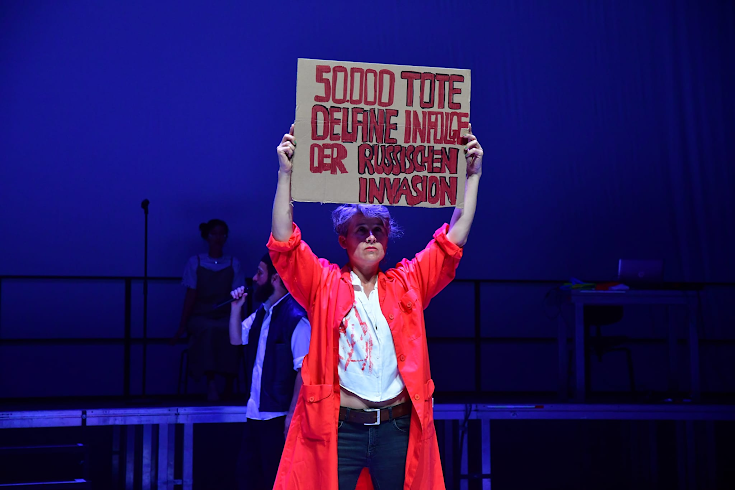
Mykola Tsypko on Roza Sarkisian’s Yes, My Führer! (2014)

Art historian Mykola Tsypko saw a performance in Kharkiv that leaves a lasting impression and speaks to the present.
People used to say that television would kill theatre, and later that the internet would destroy television. Recent events show that things are not so simple. The internet has become an integral part of everyday life and, alongside television, shapes public consciousness. Theatre, by contrast, addresses people directly — their very being, the part of them that cannot be killed: the soul.
A vivid example is Yes, My Führer!, a performance by Defacto Theatre that was included among the most anticipated events at that year’s GOGOLFEST.
Brigitte Schweiger wrote the play Führer, Order! in 1987. Its events concern the Second World War, yet director Roza Sarkisian has made a performance based on the play that speaks to the present, bringing the past into dialogue with today.
Through close collaboration with composer Oleksandra Malatskovska, who wrote the music, and the work of Defacto Theatre’s creative team, the production achieves a striking synthesis of different art forms. Its effect can be compared to the experience of Andriy Zholdak’s performances; what happens on stage recalls the musical productions of the band AVIA and Sergey Kuryokhin, while the emotional depth evokes the world of Kafka’s characters. The venue — the art basement of the Kharkiv Municipal Gallery — adds a distinctive atmosphere to the performance.
The story of this “unfinished concert for one actress, a piano and an orchestra,” as the director calls it, unfolds through the monologue of a fervent admirer of Hitler’s regime. The leading character, listed as “solo,” is played by actress Nadiia Aliunova. Her “accompaniment” is an orchestra of four actors: Oleksii Denysov, Olena Miller, Marharyta Udovychenko and Oleh Khodus.
In a critical article on teatre.ua, theatre scholar Olha Dorofieieva writes:
“With the fierce energy of a fanatic who is unshakable in her convictions, Nadiia Aliunova’s character confronts the audience with the story of a life devoted entirely to serving the Führer. The actress accompanies her tangled monologues about childhood, war and, of course, the Führer with constant movement: she jumps, falls and pours water over herself. The fractured rhythm of her existence follows the logic of madness and is reinforced by the force of the music.
The character’s actions are only loosely connected to the words she speaks: the images on stage intensify their meaning without illustrating them literally. But there is no metaphor of madness in N. Aliunova’s voice or facial expression. With complete seriousness and conviction, the actress conveys the state of a woman swept up in the mass hypnosis of Nazism, for whom almost all human values have lost their meaning. The inner world of the character is revealed to the audience with frightening clarity. The actress embodies the tense progression of her emotions, from defiantly triumphant hysteria to utter despair.”
This is a powerful experience for any audience member, regardless of age or education. What happens on stage bears down relentlessly, reaching the heart and mind and leaving no easy escape. It is fascinating to watch the audience’s faces and reactions. When the protagonist talks about her childhood and the actors portray it in a lively, grotesque way, each person in the audience activates their own defence mechanisms.
It is difficult for people today to watch calmly as the play presents the profoundly inhumane methods of upbringing that belonged to the previous century. When younger audience members begin to laugh at the cruel absurdity of an Austrian girl’s school years, the older generation’s jaws tighten and their gaze turns inward. Personal memories return: Soviet childhood, pioneer camps and Komsomol organisations. These remnants of a totalitarian system left deep scars on the people who lived through them.
Before long, the students’ laughter fades. The character’s personal tragedy and the events that follow create a sense of discomfort, intensified by the audience’s need to act. Without quite realising it, the spectators have been drawn into the game.
The performance’s aftertaste lingers. It leaves behind bitterness and a sense of guilt: because people like us fail to learn from our mistakes and keep repeating them; because we applaud the actors enthusiastically at the end, even though it has become clear that the story will end in suicide.
One wishes this performance could be seen not only in Ukraine but also in Russia — especially by those who still consider themselves the best part of humanity and approve of violence in the name of any higher ideal. For it is written: do not make an idol for yourself.