Review Thomas Irmer Fucking Truffaut Roza Sarkisian Maxim Gorki Theater
- Thomas Irmer, Body Bags With Ease Leichensäcke mit Leichtigkeit (in german)
Body bags with ease
The autumn salon at the Maxim Gorki Theatre with staged readings from an international writing workshop and a surprising co-production guest performance
In its diversity, the 6th Berlin Autumn Salon is an almost unmanageable in-house festival at Berlin's Maxim Gorki Theatre. For around two and a half months from 28 September, there will be exhibitions, cinema, concerts (with the Slovenian band Laibach making a major appearance), lectures and, of course, theatre in a wide variety of forms. The crisis nature of the present is the general theme, the geographical outline of the former Yugoslavia and Eastern Europe. The programme is so extensive that a thorough study of the offerings is an evening in itself.
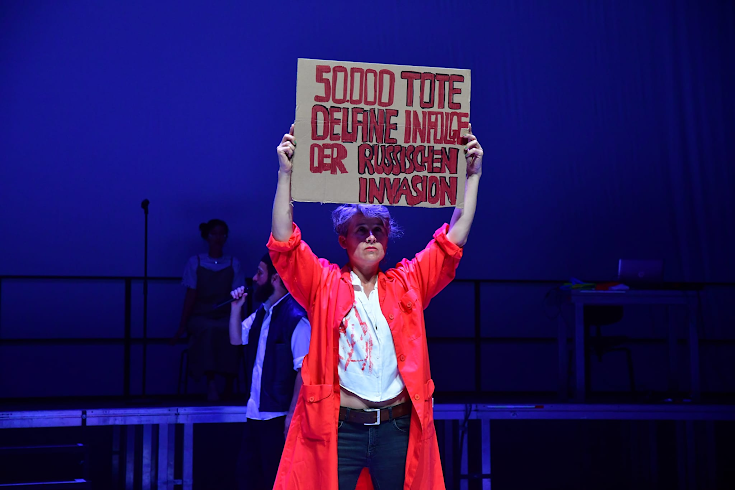
So here is an excerpt report for some contexts and about striking twists and turns in the theatrical relationship to the world of crisis and war. Last weekend saw the world premiere of "Fucking Truffaut" by the Bliadski Circus Queelective in a co-production between MGT and the Teatr Dramatyezny in Warsaw. A musical grotesque on the subject of the war in Ukraine that deliberately breaks with previous forms of representation for this subject. While the difficult to perplexing question of theatre in this war has so far been performed with more or less patriotic pathos, the Ukrainian director Roza Sarkisian and her Queelective (queer collective) break the subject down into a kind of camp revue in which Alexandra Malatskovskaya offers musical-like silent songs in English with a powerful voice and a face that flirts with the audience. Our war is your entertainment*. Fashionable furs and pillows are pulled out of body bags as donations from Western Europe, and the service at the front with the transperson Antonina Romanova serving there is repeatedly recorded on video. The mood is confusingly provocative, the whole thing is almost a breach of taboo, but after a year and a half of war and of course emotionally binding forms for the Ukraine in the theatre - as small as the thing in the MGT studio is at first - it represents a turning point towards new confrontations with the subject. Roza Sarkisian was the director of the real Hamlet rehearsals in Kyiv for the now award-winning documentary film "The Hamlet Syndrome" - which could be seen as a link to "Fucking Truffraut". The Polish curator and producer Agata Siwiak says that the appealing, rousing theatre on the subject of Ukraine is over, at least for this troupe and its queer trash aesthetic.
This applies in a completely different way to Marta Górnicka's women's choir piece "Mothers - A Song for Wartime" in which the choir - long Górnicka's method - performs texts about loss and hardship that are as depressing as they are enlightening in an ensemble of Ukrainian, Belarusian and Polish women together with a little girl. Everything here has form and power and is also touching with the expressive faces of the women under the direction of the author-director. The Berlin premiere in the Herbstsalon was celebrated with standing ovations.
While History Writes Itself was the title of the writing workshop initiated by Sasha Marianna Salzmann and led by Ukrainian author Anastasia Kosodi and Gorki head dramaturge Johannes Kirsten with authors from ex-Yugoslavian countries and post-Soviet countries such as Georgia. The results were presented in the MGT studio in short plays, each thirty minutes long, beautifully staged by experienced directors and well-cast throughout. The tendency towards the grotesque was also noticeable here, for example when Georgian author Davit Gabunia has an emigrant from his country start an impossible relationship with a Georgian oligarch's daughter in a Berlin club. Or in "Riffenstahl.UA", Kosodii turns the despised singer of a band a la Rammstein into a welcoming helper for a family that has fled Ukraine. The rule is: the weird imagination must subvert the expected and thus surprise. What is already fixed must be grotesquely loosened, otherwise it will not be able to trigger anything more than consensus boredom in the merely rehearsed affectedness.
Surprisingly then an exception, not at this pitch. "Jetzt bist du nicht mehr bloß ein Körper für mich* (Now you're no longer just a body for me*), a cleverly psychological story of abuse by Moldovan author Natalia Graur, interlaced with several leaps in a woman's biography, was a highlight of discovery in Flavia Lefevre's equally magnificent performance, still with the crumpled textbook in her hand, and again directed by Roza Sarkisian. The autumn salon as a spring bed.